
Regenerative landscape design goes beyond sustainability, wherein the design concepts create landscape elements that build upon one another, creating a continuous positive feedback loop between the soils and the plants. In an arid environment, the two most important considerations are water and soil.
A landscape that has a primary focus on water harvesting will give plants access to a soil that infiltrates and holds more moisture. A soil that holds more moisture not only gives plants access to water, but perhaps more importantly, it gives rise to a healthy soil microbiome.
There is literally no way a plant will have access to the moisture and nutrients it needs without a vibrant soil ecosystem. Soil microbes, especially soil fungi, release nutrients from the organic and mineral layers of soil, giving plants direct access to these nutrients, and soil moisture that they couldn’t obtain on their own. Soil microbes are killed by heat, ultraviolet light, and desiccation making water harvesting the most critically important aspect of the landscape.
Since climate change is advancing dryland drought conditions, it is more important now than ever that we design our gardens to capture and infiltrate all available moisture.
Permaculture earthworks are passive rainwater harvesting landscape-shaping features that capture, slow, soak and spread water in the soil, either by slowing it down to infiltrate or by creating water-holding features, which increase plant productivity, support wildlife and help heal the land. Earthworks can also be used to prevent or mitigate erosion and are often built as an initial step in a permaculture design, forming the foundational structure for other elements like food forests comprised of plant guilds (discussed below).
Passive Water Harvesting and Erosion Control
Passive water harvesting and erosion control can be thought of synonymously! When we increase the soil’s capability to infiltrate water via passive water harvesting techniques, we simultaneously are controlling erosion.
Most New Mexican ecosystems are considered arid to semi-arid drylands, thus, too dry to support a forest ecosystem. These steppe ecosystems can be characterized by grass lands, covered with drought tolerant shrubs and trees. It is important to note that the soils in this particular ecosystem are very fragile, and highly susceptible to sun exposure, wind erosion, and water erosion. For these reasons, passive water harvesting techniques can greatly enhance the soil’s capability to utilize water, and protect the soil microbiome from UV radiation and desiccation. Protection of the soil, while simultaneously utilizing precipitation efficiently, promotes a landscape that can thrive.
Below are forms of passive water harvesting and erosion control concepts that have proven to be extremely useful in planning and maintaining a healthy landscape in many parts of New Mexico including the East Mountains.
Below are some of the more common earthworks that designers like those at Cactus Rain employ.
One Rock Dams
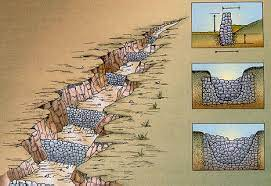
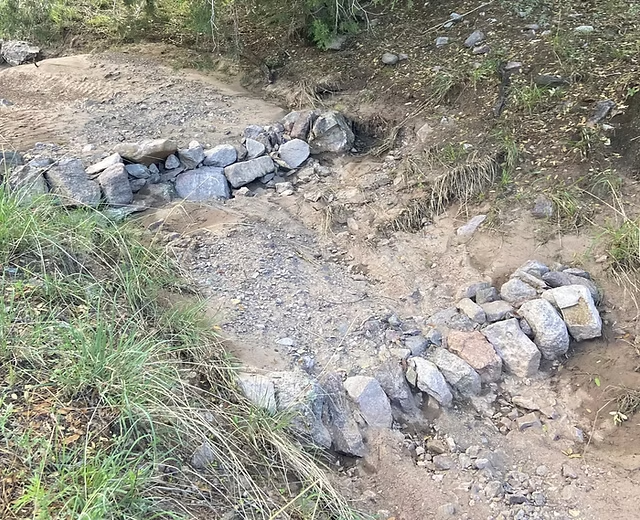
One rock dams are simple structures that both harvest water, and control erosion. Interestingly, they can be thought of as a ‘drylands swale’ because they are installed on contour like a swale, but require no movement of top soils, or subsoils. One rock dams are intended to control the damaging aspects of a phenomenon called ‘sheet flow.’ Sheet flow is a term used to describe the way water moves off the soils in an arid ecosystem during precipitation events. In most cases, due to poor vegetative cover, low organic matter, and significant slopes to the land, during rainstorms the vast majority of runoff water is lost to the ecosystem and greatly contributes to erosion. The water running off the surface does not infiltrate into the soils, and as it runs off the surface (sheet flow) it picks up soil particles, organic matter, and most importantly the scarce seed stock from native grasses and shrubs. Each of these items caught in the runoff are therefore lost to the ecosystem, making it even less likely that area will be capable of regenerating on its own. One rock dams are a simple way to eliminate all of these issues! Installed correctly, one rock dams will function as a swale – holding soil moisture as it captures sheet flow from the surface. These structures not only capture the water, forcing it to move slowly in between the cracks in the rocks, but they also provide a nucleus point to begin the restoration process. One rock dams contribute to the following ecological and biological enhancements:
• Increased soil moisture by slowing, spreading and sinking runoff water.
• Sediment deposition. Soil particles, especially organic matter, being picked up and transported by runoff water is dropped out at the upside of the one rock dams where it begins to accumulate. Accumulation
of organic matter at this point helps to provide a food source for microbes, and enhances soil moisture and infiltration capacity.
• Seed deposition. Native seeds that would otherwise be washed away, off the slope, and away from the landscape, are now captured and covered with sediment – what a concept! The seed now has a niche in which to germinate in a soil that is superior in quality to the surrounding environment.
• Arid ecosystem establishment. If installed as shown in the specifications provided below, one rock dams are a nucleus point in the landscape design where native plants can be established with very little human input. The reason for this is that the rock provides protection of the seeds – birds and other mammals/reptiles have no access to the seed under the rock. If the plants are grazed upon by animals, the roots are still protected and grazing stimulates a robust root growth. The rock acts as a mulch and holds moisture for longer periods of time than bare soils, and these wetter soil conditions contribute to an active soil microbiome. Once the grasses/shrubs have established at the one rock dam epicenter, they can begin to spread into the surrounding environment in all directions. As the one rock dam matures, it will begin to disappear into the landscape and be covered in vegetation.
Rain Gardens
Rain gardens are simple, but ingenious! A rain garden is a depressed area in a landscape that collects, absorbs, and filters rainwater, greywater and stormwater runoff from impervious surfaces like roofs, driveways, and sidewalks. Unlike a pond or wetland, a properly functioning rain garden holds water for only a short period (typically 24–48 hours) after a storm, allowing it to slowly soak into the ground but not permanently pool. Importantly, it can absorb 30% more water than the same size area of lawn!
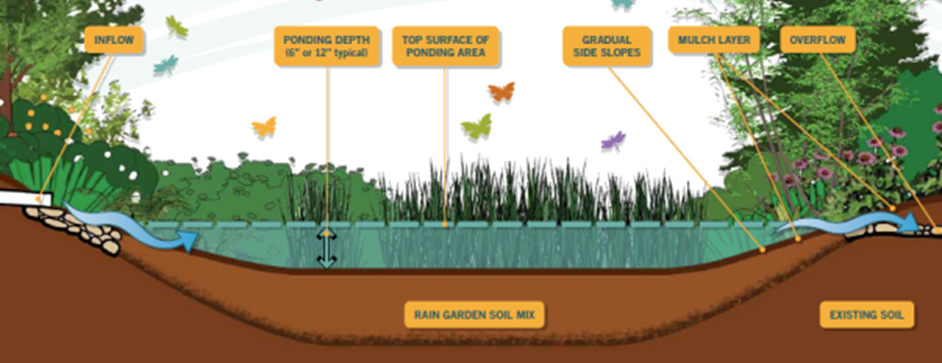
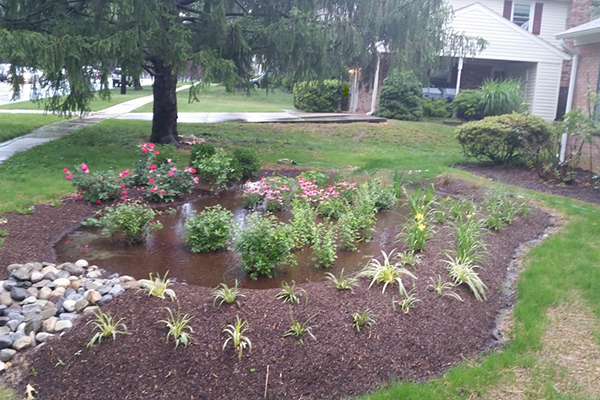
Key functions:
Water management
- Conserves Water: Can use greywater to create lush, low maintenance edible, ornamental and beautiful landscapes.
- Reduces stormwater runoff: By intercepting rainfall, a rain garden reduces the volume and speed of uncontrolled water, which helps prevent flash flooding and erosion.
- Improves water quality: The soil, mulch, and plant roots act as a natural filter, removing up to 90% of excess nutrients and chemicals and up to 80% of sediment before the water enters the ground. This includes pollutants like oil, pesticides, fertilizers, and pet waste.
- Recharges groundwater: Instead of flowing into storm drains, rainwater slowly soaks into the ground, replenishing the local groundwater supply.
- Prevents waterlogging: Rain gardens are designed to drain within 12 to 48 hours of a rainfall event, preventing standing water and the creation of mosquito breeding grounds.
Ecological benefits
- Increases biodiversity: Rain gardens provide food and shelter for native wildlife, including birds, butterflies, and beneficial pollinating insects.
- Provides habitat: By planting native species, rain gardens create a habitat that supports local ecosystems. Native plants are adapted to the local climate and soil conditions and help to improve soil health.
- Mitigates the heat island effect: The vegetation in rain gardens helps to cool the surrounding air by absorbing heat from hard surfaces through the process of evapotranspiration.
Aesthetic and property benefits
- Enhances landscape aesthetics: With a thoughtful selection of site appropriate perennials and annuals, rain gardens can be lovely and unique additions to a property. They can be designed in a variety of styles, from naturalistic to more formal.
- Increases property value: The aesthetic appeal and environmental benefits of a rain garden can increase a property's overall value.
- Low maintenance: Once the rain garden plants are established (typically after the first year), they require less watering, fertilizer, and pest control than traditional landscaping.
- Cost-effective: Rain gardens offer a relatively low-cost way to manage greywater and runoff from your property.
Swales
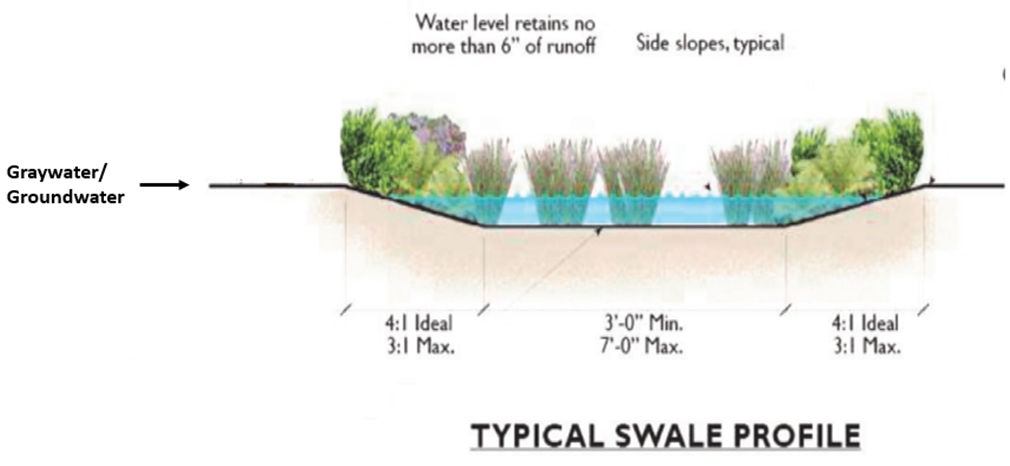

Swales are shallow, open channels built to absorb and use rainwater, greywater and groundwater to passively irrigate plants, reduce the speed of stormwater flow, filter out pollutants, and promote infiltration into soil. They are also cost-effective and environmentally friendly alternatives to traditional storm drains and can create abundant ecosystems which last for decades. Swales serve all of the functions as rain gardens with an emphasis on mitigating erosion and flooding especially on gently sloping terrain, typically with a grade between 1%-5%.
Berms
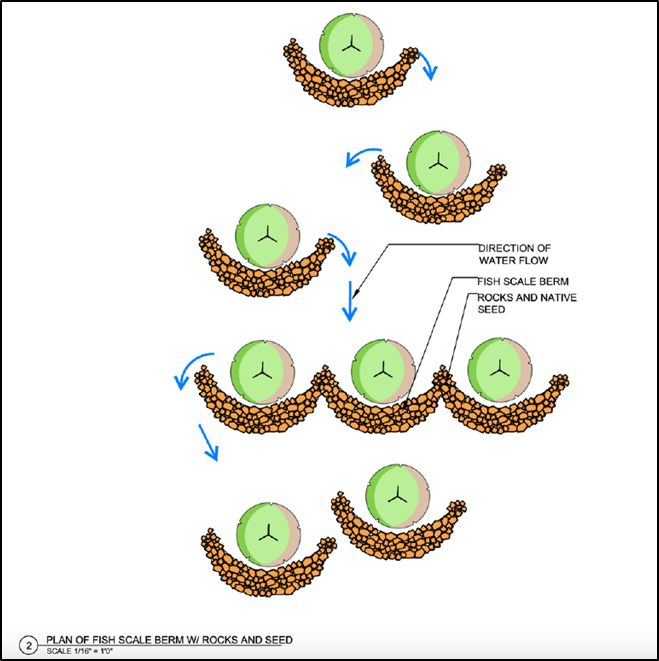
Berms can be used to harvest stormwater from rain events that produce sheet flow. Sheet flow is the movement of water off the surface of the soil when soils are not capable of infiltration. This is very common in the high drylands ecosystem. Anytime soil water can be captured and infiltrated, the surrounding ecosystem will be more resilient to changes in climate and drought. It is important to note that berms in the drylands require stabilization, or they will simply erode away over time. A great way to utilize berms is by combining the one rock dam strategy of growing native vegetation. “Fish Scale” berms can be installed on a slope that capture and direct water to multiple trees/shrubs as water fills and overflows from each berm.
Plant Guilds
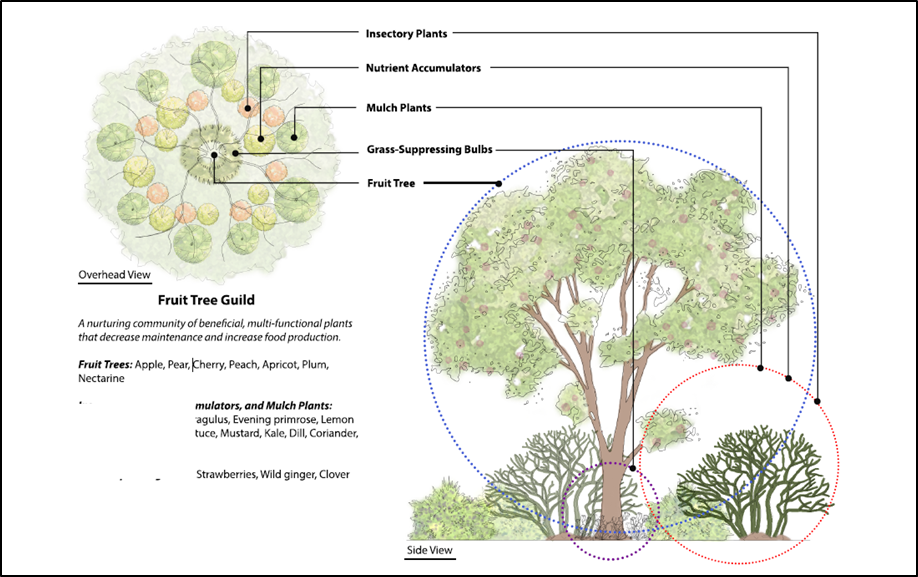
Plant guilds are collections of mutually beneficial plants grouped together to create a small, self-sustaining ecosystem. Guilds are critical elements in a sustainable landscape. In nature, plants work together as a community of organisms, and each respective plant has a purpose. For example, a tree will grow very deep roots and bring soil moisture levels up via hydraulic redistribution. Under the canopy of a tree, a microclimate is born. With a cooler environment, understory plants can thrive. A series of shrubs and perennial flowers and cane berries can thrive under a tree in dryland climates. Roots begin to work together to hold soil, minimizing soil erosion. Vegetative cover creates a living mulch, keeping the soil free of strong electromagnetic fields (EMF) from the sun and enhances soil moisture capacity.

Plant guilds are collections of mutually beneficial plants grouped together to create a small, self-sustaining ecosystem. Guilds are critical elements in a sustainable landscape. In nature, plants work together as a community of organisms, and each respective plant has a purpose. For example, a tree will grow very deep roots and bring soil moisture levels up via hydraulic redistribution. Under the canopy of a tree, a microclimate is born. With a cooler environment, understory plants can thrive. A series of shrubs and perennial flowers and cane berries can thrive under a tree in dryland climates. Roots begin to work together to hold soil, minimizing soil erosion. Vegetative cover creates a living mulch, keeping the soil free of strong electromagnetic fields (EMF) from the sun and enhances soil moisture capacity.
Guilds also allow for efficient irrigation– instead of watering a single plant, a guild creates an entire new ecosystem by watering a single tree. Each plant in a guild serves one or more of these specific functions to support the health of the entire system:
- Central plant: The main tree, shrub, or vegetable that is the focus of the guild and provides the primary yield.
- Nitrogen fixers: Plants like clover, beans, or Siberian pea shrub that work with soil bacteria to convert atmospheric nitrogen into a form that other plants can use, reducing the need for fertilizer.
- Dynamic accumulators: Deep-rooted plants, such as comfrey, yarrow, or dandelion which "mine" minerals from deep in the soil. When their leaves drop and decompose, these nutrients become available to shallower-rooted plants.
- Insect attractors (Insectaries): Flowering plants like dill, borage, and calendula that attract pollinators (e.g., bees) and predatory insects (e.g., ladybugs) to help with pollination and natural pest control.
- Pest repellents: Plants with strong scents, such as lavender, sage, or marigolds which can confuse or deter harmful insects and animals.
- Ground covers: Low-growing plants, like creeping thyme, mint, or strawberries, that suppress weeds, retain soil moisture, and prevent erosion.
- Biomass plants (Mulchers): Plants that produce a large amount of leafy material, which can be cut and dropped to act as a natural mulch for the soil.
Conclusion
As you can see, there are multiple ways to use rainwater, greywater and stormwater in your landscape. Features like rain gardens and swales are highly effective at leveraging water from sustainable sources to create long-term, lush landscapes which increase in abundance and decrease in maintenance over time.
Cactus Rain designers specialize in helping homeowners, farmers, ranchers, business owners and governments design, install and maintain L2L and other water systems plus sustainable landscapes. Contact us to get started conserving water and creating the landscape of your dreams!